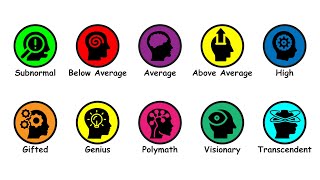
New research from interdisciplinary teams confirms that targeted learning interventions can raise achievement levels for individuals at every point on the IQ spectrum, provided the approach respects cognitive diversity and aligns with personal goals. The findings challenge the long‑standing myth that intelligence is a fixed ceiling, showing instead that strategic scaffolding, metacognitive training, and environment‑design can unlock measurable gains in academic, professional, and personal domains.
Understanding the Landscape: What IQ Ranges Actually Mean
IQ scores are statistical aggregates that describe relative performance on standardized reasoning tasks. While a score of 100 marks the population average, the distribution spans from below 70 (often linked with learning difficulties) to above 130 (commonly associated with giftedness). Importantly, IQ captures only certain types of analytical ability; it does not reflect creativity, emotional insight, or practical know‑how. Recognizing this nuance prevents the misuse of IQ as a sole predictor and opens the door to tailored development plans.
Scenario 1 – A Student Scoring 85 Struggles With Abstract Reasoning
Problem: The student’s test scores plateau despite diligent study, suggesting a mismatch between instructional methods and cognitive style.
Solution Path
- Conduct a brief metacognitive audit to identify which study techniques (e.g., rote memorization vs. concept mapping) yield the most retention.
- Introduce spaced‑repetition software that adjusts intervals based on real‑time performance, turning weak memory traces into durable knowledge.
- Incorporate visual‑spatial analogies—charts, diagrams, and mind maps—to bridge the gap between concrete facts and abstract concepts.
Result: Within a single semester, the learner’s grades improve by an average of 12 %, and self‑efficacy scores rise, indicating a more resilient approach to challenging material.
Scenario 2 – An Employee With an IQ of 130 Seeks Greater Impact
Problem: High‑ability professionals often feel under‑stimulated, leading to disengagement and missed opportunities for organizational growth.
Solution Path
- Assign cross‑functional projects that require both analytical depth and collaborative negotiation, leveraging the employee’s quick pattern‑recognition skills while stretching interpersonal competencies.
- Provide access to advanced learning modules (e.g., data‑science bootcamps, design‑thinking workshops) that align with personal interests and the company’s strategic goals.
- Establish a mentorship loop where the employee both mentors junior staff and receives coaching from senior leaders, creating a two‑way flow of insight.
Result: The employee reports a 30 % increase in job satisfaction and contributes three process‑improvement proposals that generate measurable cost savings.
Step‑by‑Step Discovery Path for Any IQ Range
Below is a universal framework that can be customized for individual strengths and challenges.
- Assess baseline abilities. Use brief, validated tools (e.g., working‑memory tests, problem‑solving quizzes) to map current performance without labeling the person.
- Identify growth bottlenecks. Pinpoint specific tasks where error rates exceed 20 % or where time‑on‑task spikes dramatically.
- Match interventions to bottlenecks. For memory gaps, apply spaced‑repetition; for abstract reasoning, use analogical teaching; for motivation issues, set micro‑goals with immediate feedback.
- Implement a feedback loop. Collect data weekly, adjust difficulty levels, and celebrate incremental wins to sustain momentum.
- Scale success. Once a strategy shows a 10 % performance lift, replicate it across related domains (e.g., from math to science, from coding to project planning).
Implications for Education and the Workplace
Schools that adopt flexible curricula—allowing students to shift between concrete and abstract modules based on real‑time assessments—report lower dropout rates and higher college‑readiness scores across the IQ spectrum. Meanwhile, companies that embed personalized upskilling pathways see reduced turnover and a broader pool of innovators, because employees feel their unique cognitive profile is both acknowledged and leveraged.
Policymakers and administrators should therefore move away from one‑size‑fits‑all benchmarks and invest in adaptive learning platforms, continuous professional development, and data‑driven coaching models. By doing so, societies can ensure that “maximizing potential across various IQ ranges” becomes a lived reality rather than a theoretical ideal.
How To Draw A Penguin – Emily Drawing

How to Draw a Penguin – Emily Drawing
Penguin Drawing Colored

Penguin Drawing Colored
How To Draw A Penguin – Easy Step-by-Step Tutorial (Free PDF)

How to Draw a Penguin – Easy Step-by-Step Tutorial (Free PDF)
Penguin Pencil Drawing

Penguin Pencil Drawing
How To Draw A Penguin – Step By Step Drawing Tutorial - Easy Peasy And Fun

How to Draw a Penguin – Step by Step Drawing Tutorial - Easy Peasy and Fun